Illinois: Technology Helps Gianna Keep Up in Class
Gianna using an adaptive keyboard connected to a laptop.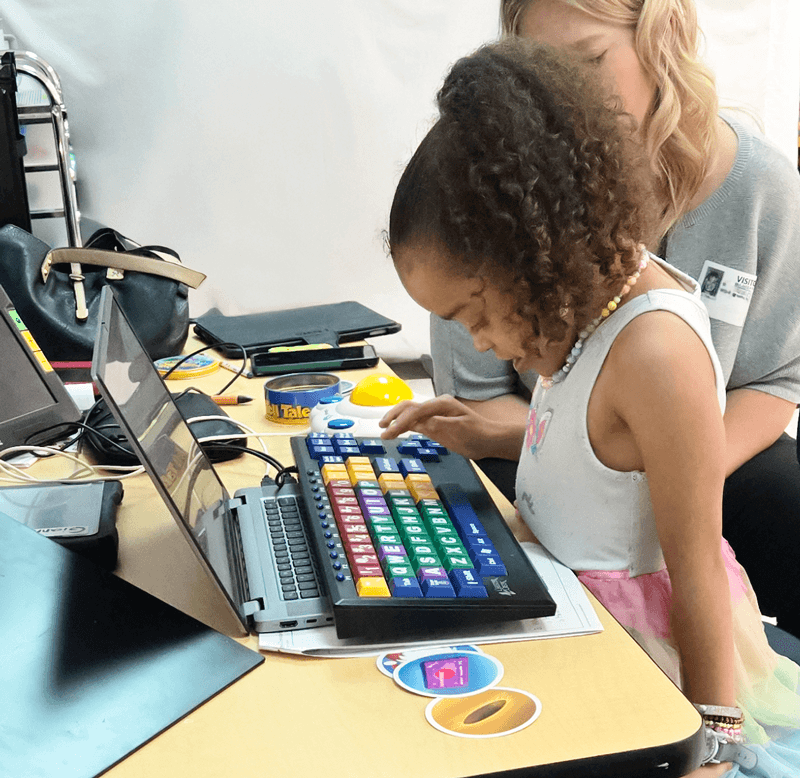
April 22 is Assistive Technology Awareness Day! Assistive Technology (AT) plays a very important role in supporting independence for people with disabilities. AT includes any device, equipment, or system that is used to enhance functional abilities of people with disabilities.
Across 56 US states and territories, AT programs transform access to life-changing technology. These statewide, comprehensive, consumer-driven programs help people of all ages and abilities test and get access to the AT tools they need to live, learn, work, and thrive—wherever life takes them.
Check out Gianna’s story from the Illinois Assistive Technology Program (IATP):
Bright Tools, Big Progress: Technology Helps Gianna Keep Up in Class
Gianna, a first grader, has vision difficulties along with coordination and attention challenges resulting from a brain injury. These challenges made it difficult for her to fully participate in classroom activities. Fortunately, she has a strong school team—including her teacher, occupational therapist, and vision therapist— who have implemented several assistive technology (AT) supports. These included high-contrast boards with colorful backgrounds and a slant board with a clip-on light to bring reading materials closer and improve visibility.
Despite modified pencils and therapy supports, reading and handwriting remained difficult. Gianna often lost her place while reading, and writing was slow and tiring. Her school made a referral to the Illinois Assistive Technology Program (IATP), and an assistive technology specialist (ATS) visited her school for an assessment.
Gianna successfully trialed tools including video magnifiers, accessibility settings, a large-key keyboard, word prediction software, text-to-speech, and a rollerball mouse—helping her read, type, and participate more confidently in class.
Want to learn more about what State and Territory Assistive Technology programs do to improve access, expand the availability, and raise awareness of AT for people with disabilities and older adults? Visit CATADA, the Institute for Community Inclusion’s central hub for data, best practices, consumer stories, and resources focused on improving access to AT as reported by State and Territory Assistive Technology Programs.